
Create Ads that Sell to Your User
TLDR: Peter Denton, PSL’s long-time marketing lead, built a “context cube” that analyzes your product’s target customers, learns their bespoke voices and creates personalized marketing content. Model reviewers preferred its ads and emails over generic AI copy in 41 of 48 comparisons.
As humans, we identify with stories that speak to us. In 2016, Spotify filled large billboards with the quote "Dear person who played 'Sorry' 42 times on Valentine's Day, what did you do?" The campaign earned more than a billion impressions in free press.

PSL has a history of building marketing campaigns that speak to specific audiences. For example, in 2019, when NVIDIA released StyleGAN, a model trained on a million faces from Flickr, the PSL team used it to build a toy that modified images of people. "I could take a picture of anybody and then I could transpose them," Peter says. "I could make them younger, older, change their expression, change their gender."
Using this toy, they began creating ads for a large insurance company. They compared the large insurance company’s own ads against hyper-personalized versions where the people in the ads were demographically matched to the segment that saw the ads. The personalized ads had a 1.5% higher click-through-rate.
Fast-forward to today, we don’t need a sophisticated team to build custom ads. All we need is a deep understanding of what makes our users who they are and a model that can act on this understanding to improvise its storytelling.
Last month, Peter Denton and the team at PSL have built a tool called Context Cube that does exactly this. “Cube brings the seller's offering into the audience's language and situation,” Peter explained. When we tested the results of Cube-assisted ads and emails against generic AI-written ads and emails, 41/48 model reviewers preferred the former.
Find Your Target
The project starts with a clear target. Building this for Metergraph, Peter listed a bunch of companies Metergraph would like to sell to. Well, he didn’t quite literally list them himself. He described his ideal target (young and small companies) and the attributes of this target (e.g., employee count, industry, geographic location) and asked Perplexity and ZoomInfo to find a list of ideal candidates. The tools returned to him with a Rolodex of 565 companies, each enriched with a “company DNA page” that specified its industry, size, investors, growth trajectory, and tech footprint (tools, platforms & AI model usage).
Peter then asked Perplexity to sort them into clusters. Perplexity came back with a jumbled patchwork of ten clusters, rolling up documentation, regulated industries and AI agents into one family. So Peter knew something as vague as “sort” didn’t hold up. Getting more specific, he instructed Perplexity to sort companies by their main workflow and customer segment. He also emphasized that each company should be in only one cluster; so when in doubt, pick a side.
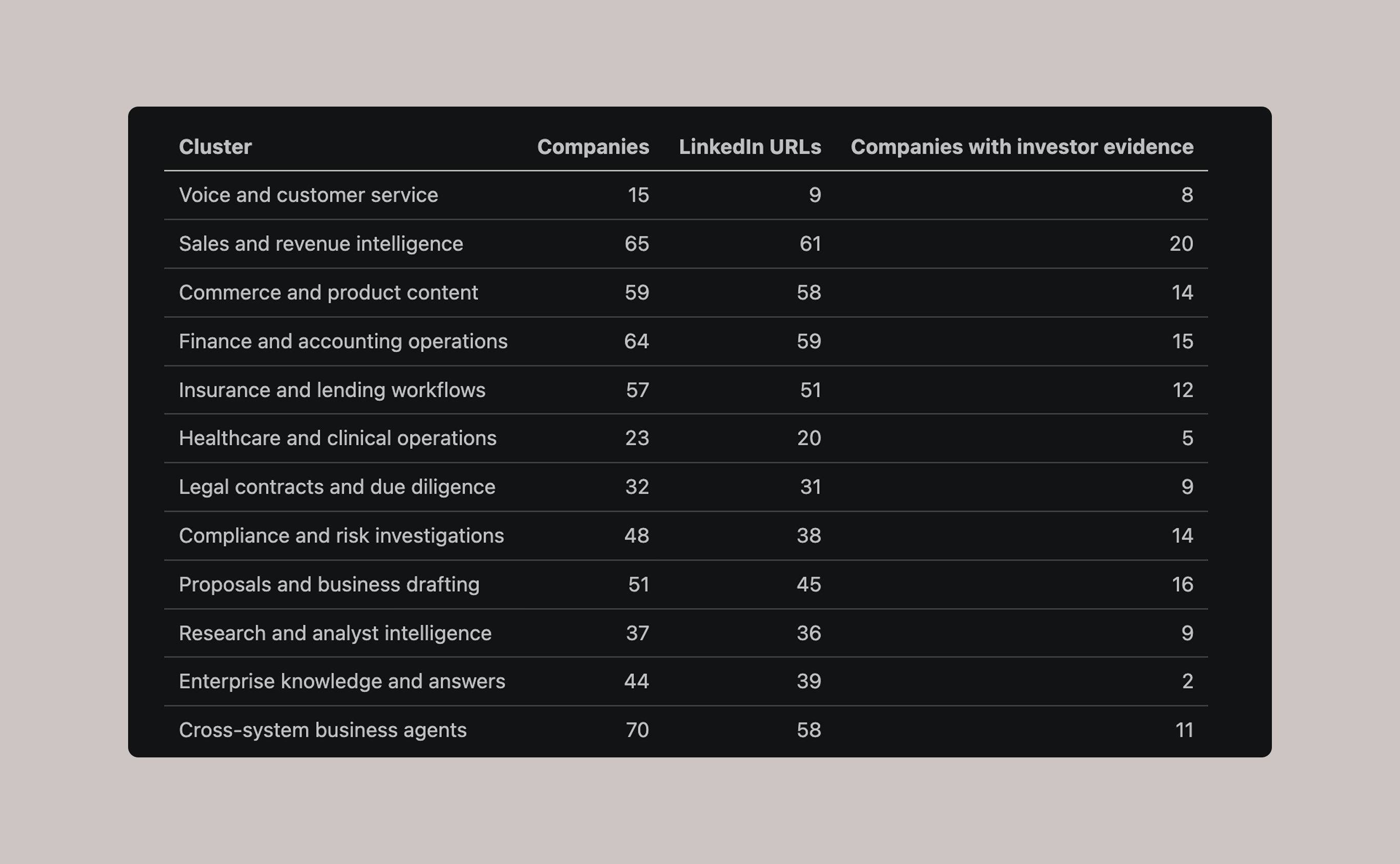
This time, it came back with 12 clusters, each holding anywhere between 15 and 70 companies. Peter was intentional about keeping the clusters small. "We have to be very precise, like shooting an arrow,” Peter suggested, “not casting a net." At this size, everything still lives in spreadsheets, so a person can open and validate the results.
After the first successful run, Peter has added other crawlers like Exa and comparing their results. Whatever tool you pick, the starting point is to be opinionated on who you are selling to and how you would define them.
Listen Before you Speak
“Once we have our clusters, we have our models build what we call cluster briefs,” Peter explained. A cluster brief captures every specific detail of how a company positions itself.
The first step to create a cluster brief is to crawl all the target companies’ public pages: landing pages, docs, blog posts, LinkedIn posts. Peter’s Python crawler is set to the above mission with some key limitations. It is not allowed to pull from PDFs, JavaScript or arbitrary external links that might dilute the company’s brand voice.
The crawlers are asked to pick out the company’s voice, positioning, prominent themes and competitors among other things. These details are then organized by company, cluster, URL and time of reading.
From that index, the models write the cluster briefs. Peter is clear that this isn't just keyword matching. "We're essentially making a style transfer rubric for marketing.” The brief focuses on qualitative dimensions such as lexicon, proof style, objections and voice.
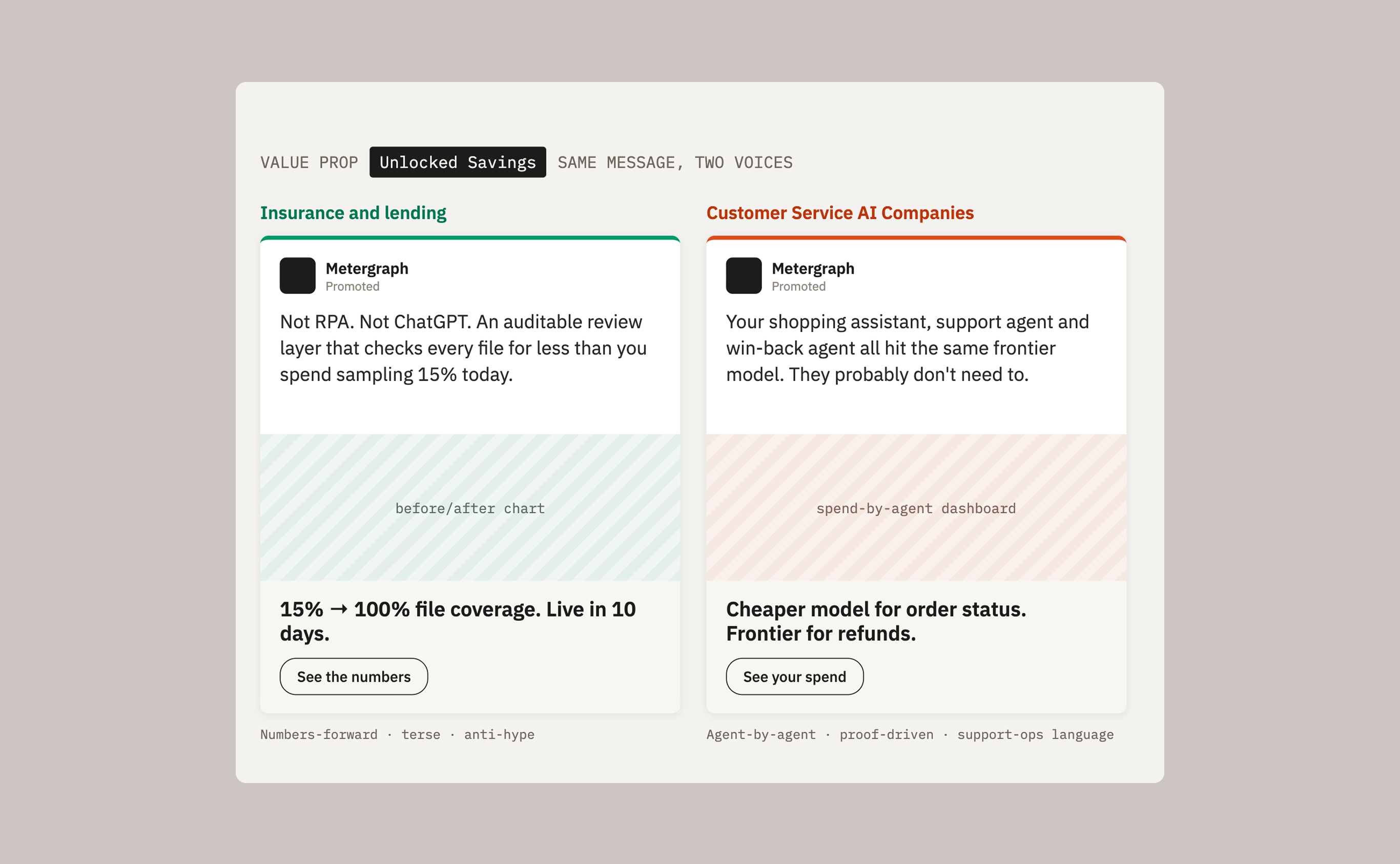
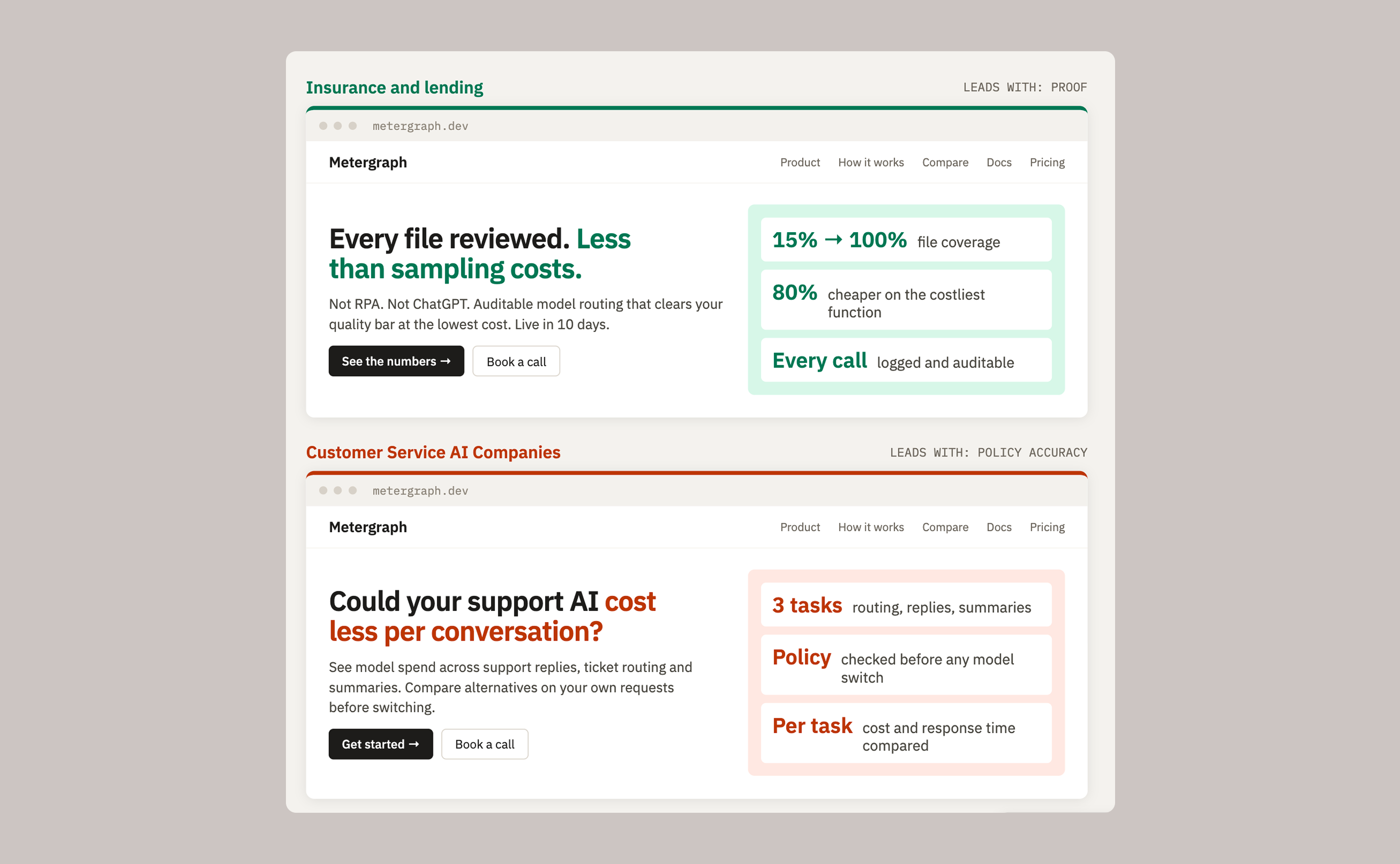
Put two briefs side by side and the clusters barely look like the same market. "If you want to speak to people in insurance, you have to talk about 100% accuracy and protection from risk." That’s not what customer service agents care about. "They want cost optimization and boilerplates for routine tasks.” The same product has to sell to the two customers in two different ways.
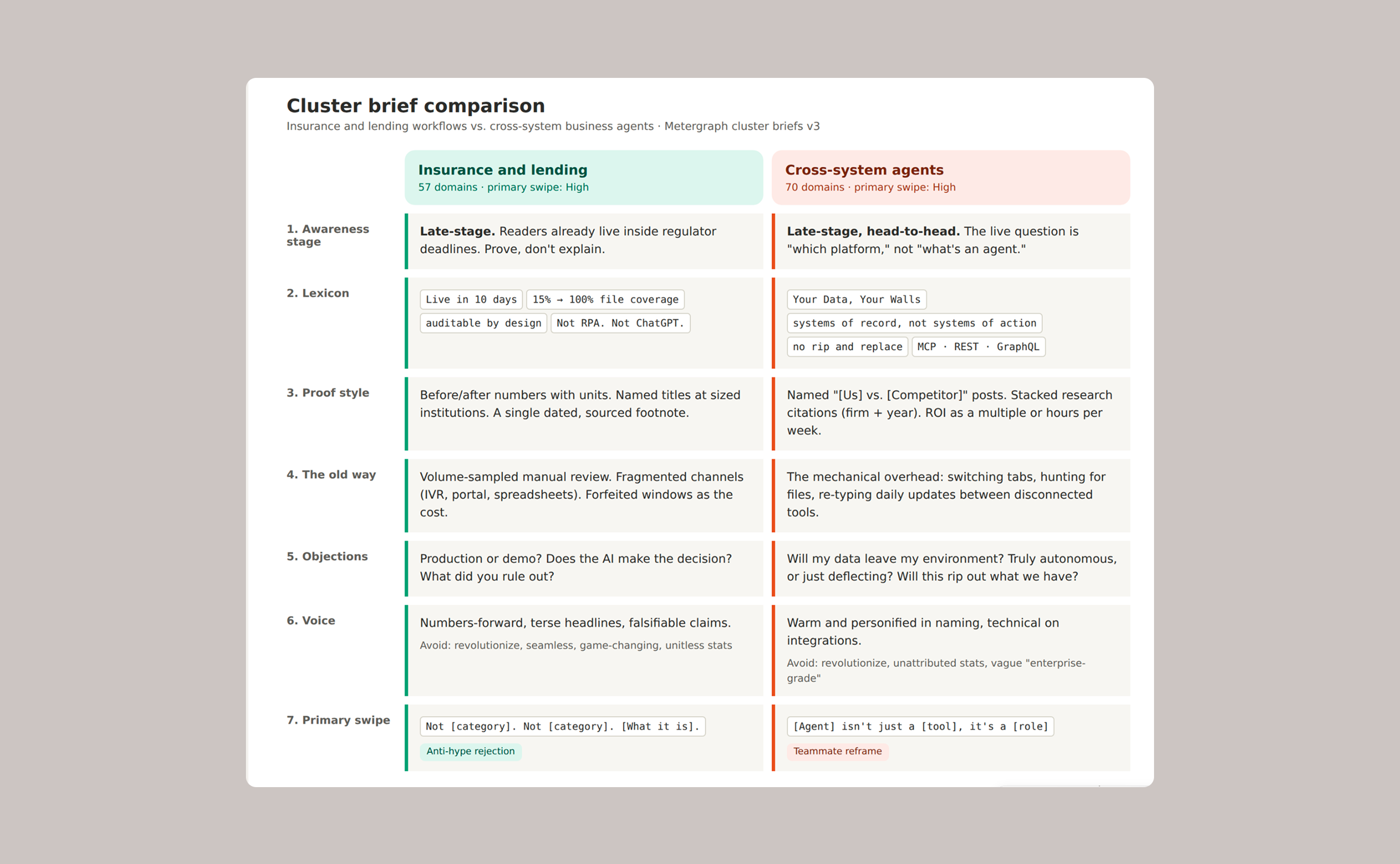
Peter has built a web interface to surface each cluster’s details. He uses this interface to review each cluster, propose corrections and update new versions from time to time. That said, he admits that a web interface is not necessary. A Markdown or JSON file does just as well.
Speak in Their Language
With that, we have a breakdown of each target audience and what they care about. The next step is to hand this context over to an AI agent that creates marketing content. "I can just sit here as a demand gen person, point Claude at the index and say, build out all my ads on LinkedIn, build out all my landing pages," Peter marveled.
An MCP connector helps Claude navigate the massive index. Claude is given read-only tools to pull out only the cluster it needs and draw information on who the audience is, what they need, what proof they care about and how they talk. A writing skill then turns that into ads and landing pages.
Peter uses his cluster-brief informed AI tools to draft his campaigns and posts, but he never lets them out without a check. Even with a ton of context, the models can be quirky sometimes, so Peter reviews the final drafts and makes edits. These edits refine the model. An edit-preferences skill snapshots the draft’s before and after, noting the changes Peter made to them in terms of the opening, tone, claim and length. These preferences are then saved for implementation in the next round.
The Market for AI Salesmen
We’ve been complaining about how AI-written content sounds like, well, AI. It seems to us that this could be because we have not taught it to write like someone else. The market is budding with tools aimed at filling this gap. 6sense and Demandbase spot who's ready to buy, and Gong records what they say on sales calls. Clay plus a language model drops a prospect's name and latest funding round into the copy, and Persado learns which words got responses in past campaigns. But knowing who a buyer is, or what they clicked, isn't the same as knowing how they talk. Peter’s Cube reads what each group of buyers publishes, learns the proof they trust and the objections they raise, and writes back in their language.
Peter is now turning his toy into a polished product. If you’re interested in what Peter has built and perfected, sign up to be an early user at cccu.be.
About Peter Denton
Peter Denton is a Seattle-based marketing leader who has spent his career figuring out what makes buyers say yes. Before PSL, he was a product manager at Cheezburger and spent nearly four years as VP of Marketing at Stellar. He joined Pioneer Square Labs in 2017 as its marketing lead and is credited with pioneering “validation marketing,” a technique for testing demand for a potential company by launching and marketing landing pages.
About Sahana Narendran
Sahana is a founding member of Lev, an MS HCDE student at the University of Washington, and a writer for the PSL blog. She builds AI agents, tools and workflows that multiply what people can get done, and she is curious about exploring new ways for humans and AI to work together.